Tuesday, 18 October 2011

Fahrenheit 451 by Ray Bradbury

09/07/2011


4
Fahrenheit 451 by Ray Bradbury is a more classical dystopia in a world where books are against the law and incinerated if found. The reason I like this book is that the premise and the world itself are very clever and believable, but I found the writing itself wanting.

I don’t want to ruin the plot (not that there is much of it) so if I seem vague, assume it is for that reason. All I can say is that it isn’t too important, I think, because it is a book designed to encourage you to think and presents you with ideas; think like Douglas Adams’ Hitchhikers Guide to the Galaxy trilogy of five books. In a nutshell, plot is peripheral, I felt.

The way the world is built in this novel is so understandably logical (and in a way, proven) that one could worry for our own books’ safety. Though the law encourages the destruction of books, books became obsolete before the law came in. It is a book about the most extreme of censorship, stemming from self censorship. In our desire not to offend others, we would censor our books to avoid this offense starting with words and phrases before gradually destroying the book itself. The other reason cited (which is more political) is that society is generally happier when it doesn’t have to think. In the achieving of this hedonism, all thought is stopped by limiting social interaction, confusing ideas and what Orwell coined “doublethink”. How? Television.

It is a different kind of television but it is the idea that these people are your friends and family and that interaction is straightforward with the technology causing you to feel something without having to go through the mental stages of reaching that emotion: through chemicals or colour. I think- this was something I sort of felt my way into understanding because Bradbury was a little wordy, but I’ll explain the way he wrote in a minute.

The other interesting pieces of technology are earpieces that play music to induce a certain mood. Sound familiar? You’re hearing the prophecy of your iPod and MP3 players! These are supposed to distract and occupy humanity. Because as long as we are occupied, we cannot stop to think: so cars drive at unimaginably fast speeds, porches were gotten rid of to discourage leisurely sitting and neighbourly chatting while the law keeps tabs on suspicious morning walkers; all in the interest of reducing free thought.

But away from the story: to prose and writing. I felt that Bradbury was just explicitly in love with ideas. While writing in the plot, he would start off down the winding road of tangent and rambling which- though coherent- made the return to the actual story sort of like dropping into cold water. Nonetheless, it was interesting. Yet, for me, as someone who likes the story to fit like a jigsaw and not just be held forcibly together, I found this way of writing detracted from my complete pleasure in reading. If it had been beautifully written, I would have given it the next point level.

I think if dystopia is your thing (as is abstract) you should read this, ideally before buying. It’s an ideas book and so you need to be ready to learn and absorb otherwise the book becomes are huge mess of utter confusion.

DISCLAIMER :-)
I know I babble and ramble a little incoherently, but that doesn’t mean I don’t find myself annoying as well. I would fix this problem, but it’s too difficult. I don’t have a problem with it, it just distracts me from the book a little.

Sunday, 16 October 2011

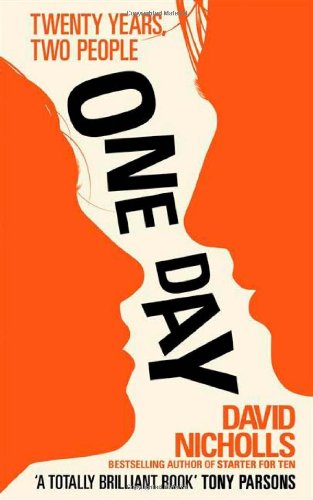
One Day by David Nicholls

4
One Day is love story, but only cliché in how the pair end up together. As someone who usually prefers romance as a peripheral sort of thing, I was mesmerised by this book and the finely woven plot. It's told strangely, one day (the same date) each year of our two main characters over a period of years, but it isn't hard to get used to; it's rather clever actually.

I think I should say, before going further, that I had actually seen the movie before reading the book, but only because it was in its last run at the cinema. I'd put off going to try and read the book beforehand, but I was unlucky. I don't think this affected my reading too much, but I did know what was going to come in the story (I jumped in the movie) so I could see some of the preemptive clues.

The book is actually really good. Like amazingly good. I was completely in love with Emma (as I think you're supposed to be) and her self-chastisement and the occasional things she says that hints at her education and intelligence despite working in fast food. I laughed heartily when reading it, which isn't that common, so I can't say this side of the story was bad. Even the kind of sad elements about her, since I got the feeling she always was so, only made her deep and realistic. She acts charming, funny and content- but she spends so much time worrying inside. It's a bit cliché but it worked well.

Dexter, on the other hand, was...something that I can't politely say. Until he grew up. When he was older and had his little rant at Emma about politics and such, I really liked him. Once he matured a little, just after he got with Sylvie, I liked him more than at the beginning. When he was younger, he was a stereotypical, handsome bachelor who did whatever took his fancy. I can't abide characters like that, and only the pricks of a guilty conscience as he did these things kept me sane and reading about him. And he's right: Emma made him a better person by being around. On the days they were together, I found him much more bearable.

The reason I would be hesitant to call it just a love story is that the bulk of what is good about this book is the parts when it isn't romance, when there are issues of identity, day-to-day problems or the general feeling that life is falling apart around you. And then the conversation afterwards, when they examine their feelings (and all that clichéd jazz), means you can see these people growing up. I suppose when a book is written as this one is, that has to be the one thing you're bound to notice: that the characters are growing up. The French saying "the more things seem to change the more they stay the same" is true in that these people grow and do things we would never have expected, but they always have the same reasons we might expect. I think perhaps that phrase kind of sums up a lot of the book. Even though it sounds bad to say it, there was no true spontaneity and we can always say that something made sense.

All in all, it not hard to see why this book was so popular, even though for me some of Dexter's scenes dragged. The ending of the book is the real killer (no pun intended) and when you get to the last third, you don't want to stop because everything is going great, everyone's happy and you just know something has to happen. But to whom does it happen?

I don't think I'll forget this book too quickly, nor will cease recommending it to anyone.

Saturday, 15 October 2011

Divergent by Veronica Roth

28/06/2011

5
Divergent by Veronica Roth was wonderful, brilliant, astounding and any and all those synonymous adjectives. I adored it; as I expected to.

It’s a dystopian novel and the society is divided into 5 factions that each seek to combat war and suffering by adopting a particular ethic and thinking according to that ethic: sticking to that above any personal morals or relations. In the books own words: Faction before blood. That means family, but I sort of think it means before yourself too: kill yourself instead of betray your faction. The protagonist is called Divergent because she- Tris- cannot adopt one way of thinking: she could fit in with many of the groups. Obviously, this causes her a load of trouble as well as a unique way to solve it.

I thought Roth wrote brilliantly almost consistently: only occasionally did I find myself being bored by some of what was going on. I think, because this is book one in a trilogy, the setting the scene and giving her and everyone else a background was a focus. Unlike some, I actually like this sort of thing because I am an information junkie; some people just thought it was pointless.

The first 104 pages were available online and before even considering buying the book, I read these pages. Now, this has never happened before. Not once have I been able to access a book in this format (free!) and it was odd. But I read it, and liked it. By allowing me to read this, I was persuaded to buy the book because I expected I would like the entire thing. I now believe every writer should do this: it means, as a reader, we can find out whether we will like the narrative and the writer themselves should we buy it. It was win-win as far as I was concerned. And even when I got the book, I read those pages again.

The book was marvellous and I shan’t rave about it for pages on end but you need to know above all else that I loved it like a cat loves a mouse, a dog loves a ball and a reader loves a good book.

The book wasn’t unbelievable though. I think that this society (the beginning Utopia) has something that could work if possible, but it isn’t. That’s of course the problem with a Utopia: that they are impossible. The reason this one was so much so was because human individuality would have to be controlled and that cannot be feasibly done. I’m not a utopian and I don’t want this is occur in this universe, but accepting the merits of this society gave me an insight to how the characters might think and react.

Veronica Roth was, lets face it, brilliant and faultless. If she’s a nice person in real life too, I think I’m in love.

Tuesday, 11 October 2011

Top Ten Books I Wish I Could Read Again for the First Time

God, what an amazing meme! I've come out of my lack of blogging because I must do this. Nicely, this also gives me two posts today, I think. Or will do.


Top Ten Books I Wish I Could Read Again for the First Time


  1. Harry Potter. Everyone will say this, but that is because it is so true. I'm full of Harry Potter love
  2. The Hunger Games. Okay, I didn't think of this myself, but I agree with everyone who did say this.
  3. The Help. I've only just recently finished it but it was amazing.
  4. The Belgariad. My favourite series ever. If I could read this again, I'd get the same smug smiles like I'm sharing a joke with the characters, or the content full face smiles when I predicted something. Fantastic series of books.
  5. Pride and Prejudice. This was my first foray into Austen's books and I was blown away that I liked it so much. I love getting something that you thought would be bearable, but ends up being one of the most amazing things ever.
  6. Eragon. Kind of my first real stab at High Fantasy that set me up in what kind of books I loved thereafter.
  7. Necropolis. It is the fourth in the Power of Five series, but it blew me away. I was terribly impressed considering the 'Meh' attitude I had to the other books.
  8. The Chronicles of Ancient Darkness. Another one of those great books. I was incredibly sad when this series ended. It wasn't a bad ending but I felt so lost when it was over. I think if I read it for the first time now, though, it would seem perhaps too young.
  9. The Elegance of the Hedgehog. My favourite book. Yes, my favourite book and series are separate. I have to break the rules of book favouritism in order to satisfy my book love. I sort of think I'd like to read it again for the second time since that was when I really fell in love.
  10. The Perks of being a Wallflower. Another great books that left me blown away when I finished. Everything just worked about that books and I can't express how wonderfully it was: both in idea and execution.
Okay: all done. I had to miss Divergent and The Road but they are both spiritually part of the list. I was also really in love with Enclave (which was like my first Austen foray) and The Millennium Trilogy which was great in its own separate right. In a way, it'd be kind of nice to just start reading again. To go through those week and years of reading and then the realisation that you love books. That you have read so many great things and then it hits you: what else is out there?

Scorpia Rising by Anthony Horowitz

22/06/2011


4
Scorpia Rising by Anthony Horowitz is the last book in the Alex Rider series. I have to admit I gave up on the books after Ark Angel which was 3 books ago (I think) but as with most readers, I kept with the series out of a determination to know what happened.

As it happened, the same thing happened that happens in every book- except that a relatively important minor character was killed and Alex Rider is emotionally broken. No biggie really: a shock, but I could have predicted it if I gave it some thought. And I saw it coming 50 pages away. Horowitz is a marvellous writer, and that is part of the reason I probably read the books as well, but I think he has a set pattern of writing that he tends not to deviate from with Alex Rider:
  1. Alex Rider accidentally recruited by MI6
  2. Starts Mission and all seems normal
  3. Clues point to conspiracy
  4. Conspiracy Discovered
  5. Starts to combat conspiracy but fails
  6. Taken into custody by enemies and all hope seems lost
  7. Rider has actually planned an getaway and succeeds
I suppose I should tell you the premise of the books now.

They follow a teenage boy (just turned 15 in this book) who is hired by the British Secret Service MI6 and goes on missions that only an agent who appears as a teenager could do. He was trained by his Uncle for this (unbeknownst to Alex) and is therefore a super spy and very resourceful. I won’t ruin any of the books, but they just deal with his missions and revealed conspiracies and more personal revelations.

They are good up until Scorpia which was the fifth book.

The plot of the book is straightforward and for the most part it was very predictable for me as someone who has read the other books by him. The prose is very good and Horowitz, ever objective, is a good writer that can make the book fast paced, engaging and very hard to put down.

The characters are always a good part in his books: they have suitable back stories, clear motives and a few skeletons in their closets. They are developed really well, but in 8 books, that’s hardly surprising. In fact, I feel that by this book he can’t go anywhere else with them so it is good that this is the finale. I think that he does a good job of tying up the loose ends (though there aren’t many that he carries over between books) and leaving a reader suitable satisfied that everything has been dealt with. It’d be nice to know what happens to Alex, but it’s not a pressing detail and can easily be overlooked.

There is the tiniest of bits of romance in the book but, by this point, Horowitz has cut it down to such a minimum that he only references it on a few occasions: there is actually no romance in this book.

I loved the books and, as I’ve said, I only read this one out of loyalty and the need to know what happens, no matter how dull. I’m content with the ending but overall this is a mediocre book compared to other ones: a cheap thrill, if you will. Nevertheless, it is not a bad read. Maybe I’ve just gotten tired of the books over time. I give it a 4 only because of previous like of the trilogy and Horowitz’s writing.