Sunday, 12 July 2015

Long Time No See

So it's been over a year since my last post on here, and I think it's about hightime I rectified that. I'm in my second year of university now, so that eats up my time like no tomorrow, and in that time a great deal has happened for me personally in changes, and significant events in my life. But that isn't why I'm posting.

I have, now, a list of about 20-30 books I've read over the past 24 months and I'd really like to get some reviews written up, so I'll be writing them this summer and hopefully posting them all online over the course of a few months, around 1 or 2 a week.

Sorry for the silence, I'm working on it.

Alex.

Wednesday, 9 April 2014

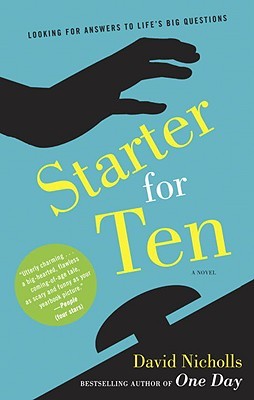
Starter for Ten by David Nicholls

3

Starter for Ten

(Read 2013)

This is a book by the same author who wrote One Day (an excellent book whose review can be found here) and this was a birthday gift by someone who was sure I would like it, having never seen the film.

This is a book I put off for a while, and for good reason. The book itself wasn’t bad and enjoyed the general plot and setting. Nicholls has this talent which is used to good effect of writing books which exist in a very realistic setting and which are simultaneously mundane and interesting.

The film is a Rom-Com-esque affair, and the book is the same. Our main character is infinitely obsessed with his own self-appearance and finding a relationship with exactly the person he wants to be with while forgetting and ignoring more important aspects of his life. It’s a fairly typical coming of age story and the plot moves along nicely without plodding overly-much.

There’s very little I can say on the subject of the plot (beyond a typical synopsis) that can’t be said. It’s your average novel of a typical student and the things he gets up to in that and although it isn’t boring, it is infinitely mundane. The two things worth mentioning are the romance and the central event.

The latter is easier, so I’ll start there. The book is all about University Challenge- a British TV series which pits the teams of British Universities against one another in a competition of general knowledge, which is either very interesting and informative or dull and inane depending on which side of the fence you’re on. It’s essentially a daytime television so which is but more relevant. But the plot of the book is our protagonist wanting to be on this team and do well. He’s an intelligent lad and the entire thing is relevant mostly as a plot device, but in many ways I also felt it was a reflection of our MC himself because he obviously thought and ability to remember things meant he was intelligent and he concentrated on knowing facts. Maybe I’m just fundamentally different, but this irked me as a student myself because my degree (Maths) teaches that understanding supersedes just knowing facts because it is  way of thinking which they want to teach you and if all you do is memorise, then what have you learnt that you’ll actually remember? I find the whole things fairly bizarre, but then I have a poor memory for general knowledge. Maybe because I think of it as a little irrelevant.

The romance was...cringe-worthy. I won’t say too much on this because it reveals too much, but it was predictable and unsatisfying. It reminded me of One Day in that respect because Nicholls give you a (painfully realistic) non-perfect ending. It is a non-issue, but it makes the book weird and you can’t help but feel for the poor guy in his endeavours.

Not a bad book, but certainly not amazing. I think if you’re looking for an easy read over a period of time where you don’t have the hours to dedicate to reading, it’s easy going and not hard to follow. The downside of this is that I found it sometimes uninspiring thing to sit and read.


Wednesday, 2 April 2014

The Dead Tossed Waves and The Dark and Hollow Places by Carrie Ryan

4

The Dead Tossed Waves and The Dark and Hollow Places

(Read 2013)

These are the next instalments in the Forest of Hands and Teeth series. This is going to be a simultaneous review simply because I read both in such a short space of time that they aren’t really separate books in my head. (So if I say ‘this book’ I don’t distinguish between the two, although I know they are respective books!)

Firstly, wow.

A lot happens in these books. The Forest of Hands and Teeth is but a prequel to the events that go down. In many ways, it is that book that lets you see what the world is like before Carrie Ryan takes you on this amazing journey.

In general, the story and world are amazing. This is post-apocalyptic and it is completely understandable what is done even if we must disagree and not approve of everything. It makes it fascinating because you face moral dilemmas (from the safety of your armchair or bed!) that are almost worrying that you might think. I question who I agree with...and concluding that I agree with the idealist and the pragmatist/survivalist I don’t know where I stand. The plot nicely moves along and it never feels too centralised and dull- even without great movement (sometimes) there is always fantastic pace and Carrie Ryan uses her environment and world to great effect. Zombies are ever-present and this is taken full advantage of which makes both books engrossing and “unputdownable”.

The characters in both books are the same in terms of our main protagonists although obviously the cast of side characters differs between the two as befits the setting and progression of the story. But the characters...oh lord! There are circles within circles, triangles within triangles. It like trying to endless half a number...it just goes into the infinity of numbers and it won’t end. Now imagine each of those halves is a part of the characters personality and they are built of these endless inconsistencies. Well now consider there are four main characters. Add in one or two important side characters who are similarly halved. You just have this huge amazing mess that creates this powerful, human characters. Now, I ain’t saying they’re perfect, but they are darn good...and they make for excellent reading.

So in general, I am very fond of these books. They were a huge improvement on the first and much more nitty-gritty. I’m taken along in this journey...I read these books over a two day period whilst on holiday and I was thrown into a rut after finishing (and after the first of the two books, the beach we were staying became infinitely eerie!). These come highly recommended.


Wednesday, 26 March 2014

Empire State by Adam Christopher

3

Empire State

(Read 2013)

This book was semi-steampunk, somewhat of a hero novel, a little bit of mystery and whole lot of crazy. I felt like I was reading in a stupor the entire time and I don’t think the entirety of the novel was even consistently interesting...but it was a unique read.

The beginning threw me through a loop because it is highly disjointed and where as multiple viewpoints can work when they exist in the same literary universe, here I felt like I was little lost because things didn’t seem to fit with what was said and I only really started to get used to it when I semi-convinced myself I was reading two books instead of one. It was definitely weird.

Moving onto the book itself...it wasn’t bad really. It isn’t the most amazing book I’ve read in my entire life or even in that year, but it was little astonishing. The story came together towards the end, and it reminds of those films that you just sort of suspend disbelief of and keep watching in hope that the end explains it all. In fairness, it did, but I guess I wasn’t wholly satisfied with the ending I got.

It is also fair to comment that this is the first book I’ve read which could be aptly described as being a mystery novel because it quite successfully left me lost and confused without being completely out of the loop. But I think the combination of everything made me a little bit overwhelmed at a time when I didn’t have the liberty of frequent or even intense reading so I’d often forget bits here and there.

Overall, it wasn’t a bad book. I bought it on a whim in waterstones, and I don’t regret that purchase because it was definitely different to anything I’ve read before...for better and for worse. I think I ever try another mystery novel I’ll try something more mystery based. I’d say this book was sold as a modern-day hero book (in NYC) but that wasn’t really what I got.

In a word, my sentiment is "confused". Even now, a good few months on, I’m not 100% sure what I think of it.

Friday, 8 February 2013

The Dragon's Egg Tour


"Oh Frabjous day, Callooh Callay! It's here Resa Nelson stops today!" Welcome to the Blog Tour stop for the Final instalment in Resa's fantasy series, which includes a review then a mini-interview with Resa herself!
You can see all the blog tour stops here, some sample writing plus other stuff over here (seriously, y'all should read the mini-ebook here!), and you can buy it on Amazon, B&N and Mundania- the latter offering a discount with code MP10!

Book 4
4
Writing the last book in a series is always hard because you have to live up to the expectations created by what you have already written. You're expected to remain true to the story you've spent so long moulding and refining, and the end of a series and can make or break it in the long. Thankfully, and definitely not to my surprise, this is managed this with ease.

For someone coming from the other books in the series, it feels very much like the stage is set for the final showdown between Mandulane and the forces of the North, but after what happens at the very end of book three, you can only help but wonder what will happen. Astrid left herself in quite an inescapable situation and even though she must have escaped in order for this book to exist, it's really quite interesting to see how she escapes the sub-plot that exposes.

Where it all began...
(Book 1)
But even though the fight is coming, this book never wavers from the idea of a journey present in the previous books. It would feel wrong to see Astrid preparing for war, so instead she travels across the land in what is quite possibly a more important task to save who she can in ways only she is able. What is wonderful this time around though is that she simultaneously interacts with old and new characters. It makes a great point about there always being new things and people out there, and really flaunts Astrid for the gem she is.

Because she does make the series and the books. Her thoughts and her development are just so darn captivating to read! She's not perfect, which is cliché nowadays but is still interesting, and her imperfections are like a rash she can't shake. There is no time in these books when she just makes the decision to do something because she realises the repercussions and doesn't want something foul to happen. That's not to say she dilly-dallies, but she doesn't rush into the kind of rash decisions some protags make all the time. She's a blacksmith, who has to act carefully and considerately, even if she's under quite a bit of pressure. It's a debatable point, but the decision she makes at the very end of the book underpins a conflict of which she has been toeing the line for 4 books in total. And in my opinion, she makes the decision which is right for her. There are two choices available that would both be wrong in their own ways, so a new solution is created. It's a little heart-breaking, but it makes more sense than the other two (which as a reader leaves me very happy!).

The other main recurring characters, the dragons, also make an appearance and the question I asked Resa back in August is finally answered. We learn a lot more about the dragons in that what we learn is so much more significant. Their origins, their reasons for being, the importance of Tower Island, and the hereditary relationship with the Scaldings. It neatly ties off all those loose ends about the Dragons which were bugging me a while ago!

Book 2
Trep is back as well as the romantic interest, which poses its own kind of problem. I think she definitely loves him, but how does that tie in with her unusual relationship with DiStephan? It's very bizarre because she tries to give her all while holding back so much. And despite little actual interaction in this book, they resolve the situation in their own way.

The things I can't mention without ruining the book are all so...delectable too. This does include the namesake of the book, but that doesn't do justice to the magnitude of what egg or its origins signify. And then there's the bit with Killing-Crow which is a change of style to read (a bit like Michelle Paver's books for those who've read them!), and then the other side of the repercussions from the end of book three about whom my lips are sealed, except to say I think it was funny (I love the alchemists!) and once again true to the series.

I think that is the best way to describe this book. It was true to itself and the rest of the books and it was satisfying as an ending which can be so hard to do. And it does this without being a book about 'loose ends'- it has a genuinely interesting story and plot, with development and personal realisations! If you've read the books so far, you're sure to love this!

Mini-Interview:

-You've answered this at least twice so far, but I need to ask how you feel finishing the series? To put a different spin on it, is there anything you're glad about? Any characters, stories or anything at all you're glad to see the back of or, at least, put to rest?

I'm happy the series is over in the sense that it's a sense of accomplishment to tell a story that spans more than one novel.  At first I thought I'd be happy to be done with the Dragonslayer world ... but now I'm planning to do a spinoff series that begins after The Dragon's Egg ends!  It happened because readers were talking about how they hated to see the series end, and I started to feel that way, too.  I'm realizing that there's a lot more of the world to explore and more stories I can tell.  I'll be writing a variety of standalone novels and new series, but I'm going to try to squeeze in writing a spinoff book later this year.


-Concerning Teatree, is there more to him than meets the eye? I found him very interesting as a character, and I wonder if you considered writing more about him or if there is anything you're willing to divulge about him?
 
Alex, that's a great idea!  I like Teatree.  I see him as the most sane and reasonable person in a crazy situation.  I think he doesn't agree with what goes on around him, but he has a very strong sense of survival.  He knows he lives in a world that is becoming more dangerous every day, and he works to figure out how to navigate his way through treacherous times.  He will do what he needs to do to stay alive and protect himself, preferably without causing harm to anyone else.  I think he also has a very strong sense of compassion.  He sees the good in everyone, even the worst kind of person.  I'd love to write more about him.
 
Book 3
-Kinda Dragon-related- what's your favourite pet and/or animal?
 
I adore lizards, which I think it why it's so appealing to write about dragons.  When I was a kid I'd sit on the concrete front step of my home to soak up the sun.  I'd close my eyes and relax.  When I'd open my eyes, I'd be surrounded by lizards basking in the sun with me!  Seriously, this happened all the time.  Also, sometimes lizards would get into the house and it was my job to catch them and set them free.  I've always joked that I'm part lizard because I feel such a strong connection with them!  :-)
 
-A bit off topic but...I read on Word Spelunking how you liked Lisbeth in the Millenium Trilogy and I wondered if you think you would write a book like this? Something that cross the line from talking about horrible things and subjects readers to actually visualising them?
 
Maybe.  I think being human is so peculiar.  On one hand, people can be incredibly wonderful and inspiring.  But then there are narcissists, pathological liars, sociopaths, psychopaths, and so on.  Life and people are pretty complex, and I want to write books that explore those kinds of complexities.  So if I think the best way to make my point is by writing something graphic, I'll do it, even if it means going to the extent of being as graphic as the books in the Millenium Trilogy.  There are some scenes in the Dragonslayer books that are graphically violent -- the scene with Mauri on top of Tower Island in The Dragonslayer's Sword, for instance, and the scene in The Iron Maiden when we first meet Margreet.  I'm a pacifist, and I include graphic violence in my books because I think many people have become desensitized to violence and my goal is to underline how horrible and disturbing violence is.  I think Larsoon explored the theme of misogyny in the Millenium Trilogy, and my opinion is that's why some of the scenes are so graphic -- I think he did it mindfully and as a way to underscore his point..

Resa Nelson’s first novel, The Dragonslayer’s Sword, was nominated for the Nebula Award and was also a Finalist for the EPPIE Award. This medieval fantasy novel is based on a short story first published in the premiere issue of Science Fiction Age magazine and ranked 2nd in that magazine's first Readers Top Ten Poll. The Dragonslayer's Sword is Book 1 in her 4-book Dragonslayer series, which also includes The Iron Maiden (Book 2), The Stone of Darkness (Book 3), and The Dragon’s Egg (Book 4).


Resa's standalone novel, Our Lady of the Absolute, is a fantasy/mystery/thriller about a modern-day society based on ancient Egypt. Midwest Book Review gave this book a 5-star review, calling it "a riveting fantasy, very highly recommended."

She has been selling fiction professionally since 1988. She is a longtime member of SFWA (Science Fiction and Fantasy Writers of America) and is a graduate of the Clarion SF Workshop.  Resa was also the TV/Movie Columnist for Realms of Fantasy magazine for 13 years and was a contributor to SCI FI magazine. She has sold over 200 articles to magazines in the United States and the United Kingdom.

Resa lives in Massachusetts.  Visit her website at http://www.resanelson.com.


Tuesday, 18 December 2012

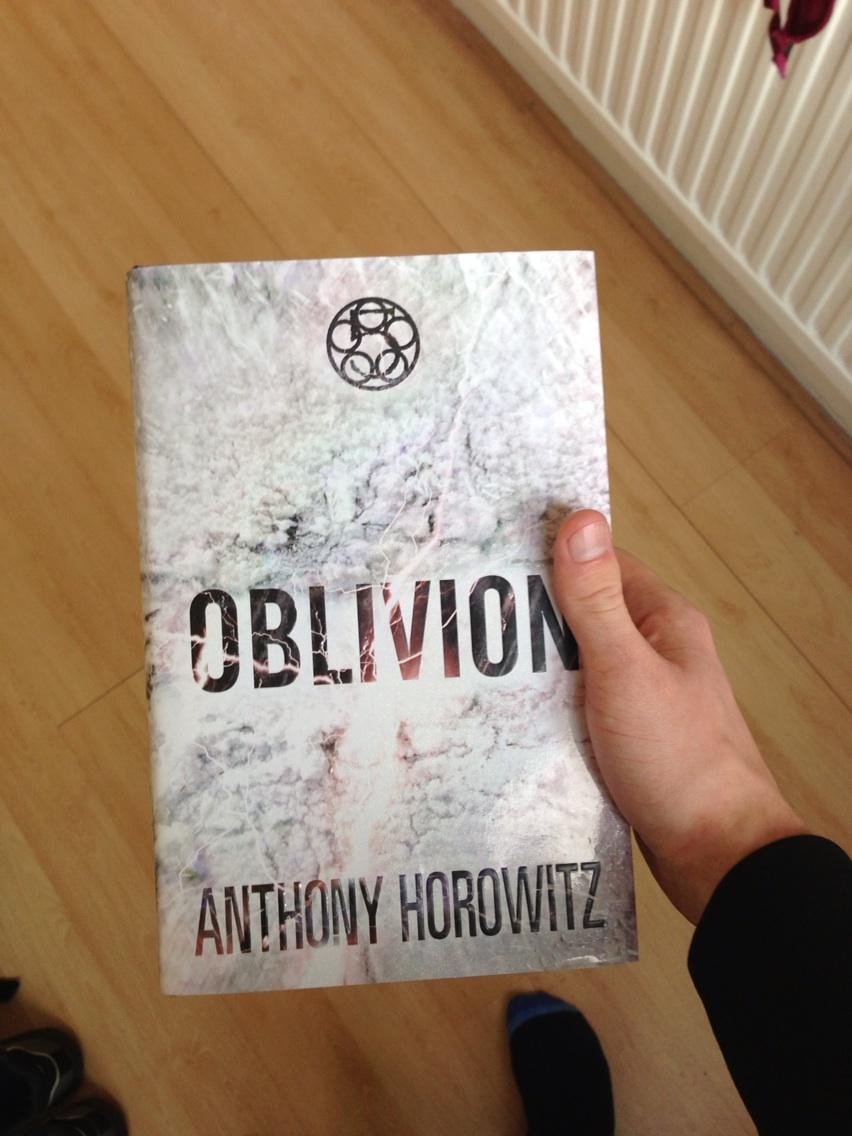
Oblivion by Anthony Horowitz


5

(Read October)

I’ve been waiting for this book so long that the day it arrived I couldn’t bear to do anything else. Anyone who has read these books (or frankly, ANY of his books) can attest to the fact of how long he takes to publish them. This is the last in a 5 book series, with the fourth book having been published in 2008…that’s four years of waiting for one book. I hoped it was worth it.

In general, I’m going to have to say it was. The book was true to form in terms of quality of writing and imagery, and it managed to bring you back up to speed without the necessity of reading all the books again, which I definitely appreciated. It also began with a really nice twist that prevented him from copping out on something he was in his rights to do. Yet this ‘twist’ also meant he could revamp the story- give it a different setting, a different feel, and also a much greater urgency and challenge. I don’t want to say what it was, since I really liked the feeling when I found out, but I’ll just say that in no way could on predict it.

Getting to the story itself…uh. Mr. Horowitz really knows how to keep me on edge. Anyone who has read some of my other reviews can attest to how much I love (adore, desire, need) the fantasy “power” element in these kinds of books. They will either make or break the book for me, because they need to be grand, majestic and powerful without being showy and over-the-top. What can I say, I’m a hard man to please. But I meet my match in this man. Whenever he does the scenes with the powers, I can hardly contain my delight and my squeals of glee, but, knowing this, he very rarely let’s me have this feeling but because I love it that much, I would read on longer (lacking any part with powers) to ultimately reach that moment when I manage to squeeze some more of the unearthly delight out of him. It’s exhausting and wonderful all at the same time.

What’s a really well-done part in this book is the dystopian side of things too. The Old Ones have really gone to town on the world and it’s nice to see supernatural abilities in a decrepit, dystopian settings [1]. I’ve come to love survival type shows and scenarios during my hiatus, and dystopia offers a really nice outlet for this.

My opinion of the characters hasn’t changed. I still like Scarlet, Jaime and Richard but I find Matt increasingly frustrating. I do still lack him but, gah! That boy needs a slap across the face sometimes. My recollection of this book was also that not much time was spent exploring the characters. They had their moments and their conversations, and every few chapters we change perspectives so we can always see what they’re thinking, but I didn’t learn much else about them and it was relatively minor as a part of the book.

As with the Rise of Nine, the ending was disappointing for me. It was tremendously well-written. I’ve never been so sickened and heart-broken and moved by a YA-style book. I also kind of think this relatively traumatic ending coloured the rest of the ending for me- I wasn’t over it by the time the book ended. But in other ways, it was a little rushed and predictable. It seems that something that had happened previously was rendered obsolete for the sake of plot. But like I said, I’m a bit biased.

I loved these books: I love this book. I’d recommend anyone to read them, and I’d physically drag them around the store until they stepped out, the series in hand. But at the same time, I’m going to warn you. You get attached to the characters, even if sometimes you find them annoying or too quiet: maybe because of everything they have to go through. And then this book goes and snaps your heart in too, a malicious gleam in its eye, and blood dripping from it’s monster of a mouth. And crazily, you’ll love it while you’re hating it.

[1] If I was to ever write a book or a story, this is exactly the kind of thing I would write. I’ve known this for nigh on 4 years now. Funny, huh? J

Thursday, 13 December 2012

Rise of Nine by Pittacus Lore


5

(Read September)

(Avoiding my usual pre-empt to these books…)this is the continuation of much loved (by me) series that follows aliens-that-look-like-humans-but-with-superpowers as they start on the next stage in their journey and find the next teenager in their entourage. These are never going to be the most well-written or deep of books, but it grabs that 5 rating through sheer thrill factor.

The story, as a quick reminder, follows John Smith who set out from Paradise, Ohio, to save earth and his own planet, Lorien. It turns out that he’s an alien, and to boot he has supernatural abilities. And the antagonist- Mogadorians! Aliens hell-bent on destruction and razing planets. Though I could bore you with details of their exploits up to now, the most important thing to know is that it’s basically like a Sci-Fi action movie. The main characters move from spot to spot and in between the kind of battles that makes an nerd (or person who’s ever dreamed of having special powers) drool in contentment, they manage to squeeze on romance, vulnerability and deep-set personal issues.

Don’t take my sarcasm to heart, because I genuinely like these books. I can’t really equate them to anything else (except perhaps the original animated Avatar with Aang), but they manage to tell what is an Sci-Fi action driven story without it becoming too much. Yeah, the romance is a bit rushed and silly, and okay, the personal issues tend to be your run-of-the-mill teenage angst, but if you like these books and you read them, you’re doing it because it lets you inhabit this world where such things are possible.

In terms of the story itself, without giving anything away, I’d say this does better in that regard than the other books. There’s a clearer goal (SPOILER FOR BOOK 2 ALERT!) in how they want to rescue Sam, they want to find the others, and want to figure out a way to actually prevail over the Mogadorians. There’s also some foreshadowing which, though overplayed, made me squirm with pleasure with the thought of what it meant in a future instalment.

The only part I had somewhat of a problem with was the ending. It seemed a bit overly rushed and unexplained. You might say to me “It’s a cliff-hanger, Alex!” but there’s a difference between leaving some things unsaid and telling me absolutely nothing about what has just happened. I'm being a bit judgemental, but given how much I enjoyed the rest of the book, I think that balances it out.

I’ll say thank you to Karen of For What It’s Worth here too! This was the final instalment of a prize I won almost a year ago! She knows how much I appreciated it, but thank you again!

Wednesday, 15 August 2012

Persuasion by Jane Austen

Part of the Austen in August event hosted by Roofbeamreader.net. (Master post link.)

4
Persuasion follows Anne Elliot, the second daughter of conceited baron, and the less beautiful daughter. It follows her life in the usual Austen style of dealing with her family as a socially over-concious body and her own personal life, with the usual period emphasis on her getting married or at least finding potential suitors.

Despite that rather vague and perhaps dull little analogy, I adored this book. For me, it was so very much like Pride and Prejudice in terms of Anne and Elizabeth being similar and the story itself even sharing some similarities. Now these comparisons are very general and it is definitely not the same story, but as a general feeling for the book, it is so much like Austen's most famous novel that I think any fans of that book could feel safe to pick up this one and enjoy it.

In contrast to Pride and Prejudice, Persuasion is probably darker. It isn't really a dark book, but some parts suggest a more cultured character who sees the poverty and suffering around her- at least more than I remember Elizabeth doing- and someone who is more directly affected by evil times and nefarious people.

It's a little predictable at times. Perhaps it's a familiarity with Austen's novels, or perhaps it was me comparing it to Pride and Prejudice, but whatever it happened to be, it made the book less of a surprise but nonetheless enjoyable. Frankly, I read Austen's books because I love how she writes and how she can so aptly draw me into a story which on the outside would, to me, perhaps seem superficial and not work minutes, let alone hours, of my time. But Austen succeeds in crafting masterpieces that I love reading.

And more so than the other books I've read, I think one can see the influence and reason for the title of this book. Persuasion is a central feature in this book from early on and it is through persuasion, coercion, subtlety and even deception that the main characters work and the consequence of these actions have a number of reprecussions throughout the entire book.

Another interesting theme in the book is that of the Navy. They feature as the primary source of love interests for the characters, and the scorn of those characters Austen designates as distasteful, but not antagonists. Reading up on it, it transpires that Austen's brothers were of the Navy themselves and so it for that reason that she included and made such an exploration of them here.

Despite my perhaps rambly yet short review, I do believe that this is a quite excellent Austen novel and is one that anyone who start with Pride and Prejudice should definitely check out! (At least for the sake of discussing with me, since I could be under a self-imposed illusion!)


Monday, 13 August 2012

Book Tour- The Waking Dream by Jennifer Ford Review

 Check out a giveaway of this book: link!!!
****
This is my completely honest review; though I seek not to offend, I swear every word is the fruit of my brain and my feelings- no other.

5
This is a fantasy novel which jumps between the perspectives of two men: Commander Dante and his Captain of the Guard, womaniser Kerran. A new threat to their crime free city comes in the form of the mysterious being Rasheim, and that isn't the only problem. It's been five years since the last contact with the world beyond the desert. For Dante, it couldn't get worse... could it?

Starting this book, the fact that the name of out main character was named Dante definitely caught my attention. It's a powerful name given its (assumed) namesake and I was interested to see why this name exactly. But as I got to reading, I found I didn't care about that as much and altogether forget that line of inquiry.

I found that Dante was definitely an interesting character, simply because he was so straightforwardly normal, but I slightly disliked the constant allusion to his logical thinking. But it didn't bother me so much as he actually thought logically after that. It was almost as though Jennifer was jumping down to whisper in my ear and reminding me he was logical. Sometimes it was useful reminder, other times annoying. I got the feeling that Dante was a very much a peacetime leader. (This could just be the fact we've been doing German history in school though, so I'm being over interpretative.) This is kind of reinforced later when Kerran steps up to take the mantle and leads more.

Kerran’s introduced as a very typical kind of misogynistic womaniser, but the moment he started to actually take a place on the stage of the book, he wasn't. I'm pleased by this, since I would otherwise have been perpetually annoyed by him. But despite some sexism in his belief of Gender roles (which he does overcome) he's fairly likeable.

For the first few chapters, I felt the book was fairly predictable. It followed your basic perfect city with a forgotten past and new threat they don't understand. But then the Messenger entered the picture. Simply put, I loved her character. I loved the mystery surrounding her and though you can guess at the truth to her (and I wasn't too far off the mark) she's still a very interesting person to see develop...or rather, come to understand. You go from mystified, to one understanding, to another, to a re-interpretation of a synthesis of the latter two. Maybe others would find it disjointed or even inconsistent, but it all makes sense in the context of the book, and towards the end you probably get the single nugget of pure truth behind her. Even when you learn who she is, you still see her as the mysterious messenger, which I think is hard thing to do; to so firmly establish who she is in a short time and no matter what else she does, that first impression is over powering.

It wasn't until around Chapter 5 that I was really hooked with the book though, since it was then that the magic actually started to come in. Anyone who has read enough of my fantasy reviews knows that this is always my favourite feature of a book and though it isn’t highly explored, I thought it was great. It’s not a topic I can dwell on though without giving up important details.

The dreams are probably the last most important feature of the book I can talk about safely. They are used as a kind of dramatic device earlier on to learn what we need to know, but they become much more important as the book progresses. They also underline the prominent differences between Kerran, the fighter, and Dante, the more logical and level headed. They also add this interesting dynamic of (at least early on) trying to guess when the events are real or dreamlike. They also mean that the more fantastical things leave a faint voice saying to you “This could just be a dream.” But then they take on a different level of importance later on when they go from being dreams to something much more dangerous, much more volatile, and much more significant.

Ultimately, this is really a riveting book (which might not have shown in this review). It seems to start slow but when events start to unfold it becomes a truly excellent fantasy book and when I finished I actually looked online to check I wasn’t missing pages. It came as such a surprise, and I wanted more in that instant. I’m interested to see where the book would go from here, but I’ll be there to find out…I hope!

Why did you decide to write it?
I am very interested in ancient history, and I spend a lot of time reading about ancient times and lost civilizations, and how climates in regions have altered over time. I have also always been a huge fan of fantasy and Sci-Fi. I started mixing elements of the two things together, and I was immediately struck with the idea of the lost civilization still being alive, just forgotten. The imagery that came to mind was so powerful, I just had to write it down. As I went further into it and discovered all the characters, it became a real world for me. And I think Dante and Kerran have a valid voice that resonates with a lot of people today.

Can I ask what that idea was that was so powerful? Is it a scene in the book- and if so which one? (If that isn’t giving too much away!)
It was the idea where I originally planned to start the book, but after I got into the story a bit I decided to change how it all started and began again from scratch – although the idea is still a powerful moment in the book. I can’t say too much about it because it is going to be a pivotal moment in the sequel.

The Messenger, in my opinion, is a fairly unusual character. But then she seems to stand against misogyny and act as Kerran’s exact opposite idea of a woman. And she is just so mysterious!!! What was the inspiration behind her?   
She was one of the first characters that I knew inside and out. I needed to have a strong woman, for obvious reasons. But I did not want her to have any of the typical sterotypes of strong women; I didn’t want it to be easy to categorize her. I toyed with telling parts of the book from her point of view, but found having her silent was far more interesting. I took my favorite characteristics from my favorite women, wrapped them together, and came up with the Messenger.

Kerran and Dante are opposites, yes? Did you set out to do this, or did they develop in this way? You say that the character came to you, so did they come in a pair or differently? And while we're on them, why did you choose the name Dante? 
In many ways, Dante and Kerran are opposites. That was not planned, it just happened that way. Dante’s character came first, and he was pretty well established as to how he acted and thought. Kerran evolved to fit the need of that secondary character; still strong, but very different from Dante. I chose the name Dante because it is a strong name; it means “lasting, enduring,” and it just fit perfectly to the character in my mind’s eye.

Why dreams? You could have had mysterious letters or a journal, I just wonder why did you decide on dreams?  
Why not dreams? Dreams are a gateway for our unconscious mind, which is really the powerhouse of our brain. So many things go on in dreams, and anything is possible in a dream. There is no such thing as the word “impossible” when you are dreaming. The idea was presented before in the movie “The Forbidden Planet’ but this is a different twist. It is a dream-world, where anything is possible, so long as you have the power to do it. As with all forms of magic, there are still rules, but there is unlimited potential (for both good and evil) in the dream world.

Finally, when do you think the sequel will be out? It says in the sample the end of 2012? Can we be so lucky?!  
Right now I am planning for November 2012. If I stay on track, then the sequel will be out around Thanksgiving.

Friday, 10 August 2012

Friday Memes

Q: What would you do over if you were to start your blog again from scratch?

I'd probably plan it a bit more! Haha! I think I jumped in a bit eager and didn't really think of how available I'd be in coming months. I jumped into whatever I could- review and memes. But I couldn't keep it up as exams came, so I wish I'd had the foresight to realise that an plan accordingly. Instead I found myself stressed and annoyed because I had to drop them.

Funnily enough though, if I did start from scratch my biggest regret with probably then be ever stopping since I've a lot a year (almost) of blogging!

Unexpected Books: Which books did you have reservations about reading, but ended up loving once you did?

Despite being a lover of her now (that sounds so wrong), I was nervous about Pride and Prejudice: just Jane Austen in general. I thought that I'd just hate her romances and hate the books. Instead I love them and have read most of them- I finished Persuasion last week! She's become probably my favourite classical author and I'm now afraid to finish all her books.

I felt similar about Dickens to. The first book I picked up of his (Great Expectations) was huge and I was worried it would be too long entirely! Again it wasn't the case, and he takes the proud spot of my second favourite classic author!

Probably every sequel/sub-story I've ever read too- I mean, what if they don't live up to my precious book?


Also, check out my giveaway her for a fantasy book by Jennifer Ford, The Waking Dream! LINK!

Giveaway for The Waking Dream by Jennifer Ford


Today, I'm lucky enough to be hosting a giveaway from Jennifer Ford, author of The Waking Dream. She has offered to e-mail this book anywhere in the world, so anyone can join in! Read the information underneath to find out if this book for you, and be sure to come back on Monday for the Blog Tour stop and my review of the book!!!!

Two cities. A forgotten past. Destiny comes to call.

Cut off from the outside world by a hostile desert full of savage secrets, the city of Illamar must fend for itself. Late one night, Dante Montero, Commander and Ruler of Illamar, is confronted on his own streets by a mysterious woman bearing an ominous message from a dangerous man known only as Rasheim. Dante and his close friend Kerran, Captain of the Guard, rush to discover the identity of Rasheim and the nature of the threat posed against their city. The closer they get to the truth, the more their worlds begin to fall apart. Both men will have to rely heavily on their friendship as they struggle to comprehend the events happening around them, their past, and even the truth about themselves. They must move quickly and choose wisely, for time is running out as Dante and Kerran discover a secret plot is already underway to destroy their city and kill every last person alive. It seems the answers they so desperately need can only be found in a sequence of dreams, but in a world where nothing is as it seems, even their dreams could turn out to be deadly.

·        What types of readers will be interested in your book?
Obviously, anyone who enjoys the Fantasy/Science Fiction genre would enjoy it; but beyond that, anyone who enjoys a well-crafted story. My book does have a strong, heroic woman as one of the main characters. It is a fast moving story that quickly takes you to the heart of the action and dilemma faced by the two stars of the book- Dante Monterro and Kerran Gurtene. It has already been enjoyed by people of all ages; from young adult to mature adult.  If you are a person that enjoys to read, then you will definitely enjoy my book. It follows a non-conventional path that should intrigue even the most experienced fantasy, Sci-Fi, mystery, or fiction reader.

·        What is special about your book?  What differentiates it from other books in the same category? 
I take what I consider to be a more classical approach to storytelling. I leave a lot of the baser descriptions to the reader’s imaginings so I can focus more directly on moving the story along. This makes it appealing to more than just fantasy fans. I have had people read my book that actually do not like the fantasy genre at all, but they really enjoyed The Waking Dream. It carries a lot of focus on the characters, and how these two men discover hidden value in unexpected characters they encounter. This makes my story non-predictable yet identifiable to the reader.
a Rafflecopter giveaway

Monday, 6 August 2012

Blog Tour- The Stone of Darkness by Resa Nelson

Today I am the stop for Resa Nelson's tour for Stone of Darkness. I'm going to be reviewing the book, then there is (not-so) mini-interview with Resa to follow! To see all stops so far, click here.

This may contain some very mild spoilers from Book 1, but mostly remains without spoilers pertaining either to this one or preceding books.

4
In Stone of Darkness we return to Astrid and follow her as she tries to discover exactly what the Stone of Darkness is, and in process finds herself embroiled in the conflict with the Krystr- something she has never avoided, but never found herself heavily involved in. She has accepted her role as a Dragonslayer, but she still doesn’t know truly who she is, or her own heritage.

It was like a breath of fresh air to return to Astrid after almost 6 months, and I’m glad to say she’s still as fantastically riveting and interesting as ever. I struggled in places to remember people since I only remembered some of the main side characters, such as Lenore, Randim, Drageen, The Alchemist, Norah, DiStephan, Vinchi and Margreet. Other ones I didn’t remember I often did in time, but the first 40 or 50 pages or so were a bit confusing due to my incomprehension, but I managed to keep going and figure out who everyone was without going back to the first few books. But admittedly, I would advise anyone has read the others to perhaps read them again prior to this, just so it’s all fresh in your mind!

The story itself followed the similar track of the last two books of travelling between settlements and reading accounts of the events and conversations that take place. It means that Resa strikes a great balance between detailed, traditional fantasy and the faster more action-orientated modern fiction. It stops you from being other bored or overwhelmed, which once again makes this book a joy to read.

I was perhaps a little disappointed that the blacksmithing didn’t come into the story as much. I accept that the other side-stories perhaps are more important and indeed we could say her pre-occupation of being away from home precedes the necessity of not allowing for a great deal of blacksmithing- since she would need her own tools and smithy. Yet still I missed what was almost a learning experience when it came to the blacksmithing.

The world created by Resa is one of a complex heritage, and through Astrid we really get an idea of just how large this world is- very much beyond the village of Guell. Astrid feels the same way some people do when they travel for the first time to a foreign country- not being able to speak the native language and not knowing exactly where you might be brings home the fact that were you come from is small in comparison to the world. But it also highlights how foreigners aren’t aliens or all bad. This was part of book two, and perhaps book three merely enlarges the scale of this realisation.

Mystery is a theme in the book from the start, and as it continues new problems or questions arise- only some of which are answered and even then only partially. Originally a Blacksmith, Astrid’s problem lies in the fact that blacksmithing (I think) is a straightforward art. Doing one thing will lead to an (expected) consequence. But the chaos that grips Astrid’s world- both in a large scale and a small scale- makes it difficult for Astrid to know what to do. And we must also remember she is still relatively new to Dragonslaying too.

But Astrid is as commendable here as with most of her qualities. She’s not perfect (boy, is she not) but she feels a great deal of loyalty and responsibility to the world and the people around her. She comments in the first book (I think) that a blacksmith is responsible for everyone in a village because they make the tools used in other trades and the weapons used for defence. This duty transfers itself to the whole world and Astrid, in everything, is assured of this. She is very much a heroine in her ideas of the world and what is right, but she still remains damnably human and makes mistakes fairly often.

So, in conclusion, it was a great sequel to books two and one. I don’t think someone could just pick up this book and manage; you’d need to read the others. It wouldn’t be impossible, but I think it would overcome your inevitable confusion. But the merit of these books lies in the fact that they manage to give you a brilliant read in less than 300 pages and even manage to combat question on free-will and feminism which all appeal greatly to me as a reader. Intelligent, concise and entertaining. What more do you want from a book?

Click to find out more about Resa!
Mini-Interview


·         Where did the idea for the Iron Maidens come from? I felt, personally, that they did make sense ideologically, but did you set out early on to do them or decide whilst writing?

The Iron Maidens showed up out of the blue.  When I was writing The Stone of Darkness, my main character Astrid ended up in a real bind.  Even though I write fantasy, I want to make the action and the world as realistic as possible.  Astrid was in such a tight spot that I couldn’t see a believable way for her to get out of it by herself.  Normally, I like Astrid to solve her own problems, but everyone needs help once in a while.  So I started thinking about who might be travelling in the region where she was located that could help her, but I couldn’t think of any good solutions.  All of a sudden, the Iron Maidens popped into my head.  I immediately knew who they were and why they were there and how they came into being.  That’s one of the things I really love about writing.  Sometimes magic happens.

·         How do you feel writing from the point of view of the Krystr? These hateful misogynists make my blood boil just reading them, and I wonder how you feel writing them. Angry? Sad? Accepting?


Click for my review
Alex, thank you so much for asking me this question.  I’ve been hoping someone would for the longest time!  I believe that villainous people in real life (for example, Hitler) typically thought (or think) they’re 100% in the right and that they’re doing the world a favor.  I wanted to show how every man who’s a Krystr has a background and experiences that shaped who he is and what his opinions are.  I wanted to get into their heads and understand their point of view.  They feel justified.  They believe they’re doing the right thing.  They see themselves as heroes.  And when I researched the Middle Ages, I learned that women were considered to have less value than some animals!  That tells me that men must have felt that women were on the same level as animals, not human beings.  So the Krystrs are based on how many real men thought and acted in medieval times.  While I was writing, I started thinking about how we often learn our first opinions and beliefs from our families, and how some people never really change those first opinions and beliefs.  I know there have been some ancient cultures (such as the ancient Egyptians and the Vikings) that treated women well, but as far as I can tell, most didn’t.  I thought about how for thousands of years people have considered women as “less than” men and how these beliefs go back to times when women were considered to be on the same level as animals.  All of a sudden, I thought about how difficult it is to change beliefs that have lasted in families for hundreds and thousands of years.  It takes strength and courage and a strong sense of self to form your own opinions and to break hundreds or thousands of years of traditional thought.  All of a sudden, I felt deeply sorry for my Krystr characters because they don’t have that kind of strength or courage or sense of self.  They’re just doing what other men before them have done without question.  I think the most tragic figure in the series is Gershon because he comes so close to doing the right thing only to cave into peer pressure by Krystrs who are simply manipulating him for their own purpose.  He almost does the right thing, but he fails.  I think he’s keenly aware of what he’s done, and it will haunt him forever.  He never forgives himself.  Ironically, writing the Krystr characters has taught me to have compassion for men who act like them in our world.  I feel sorry for them in the same way I feel sorry for Gershon and the Krystrs.  So writing these characters actually changed part of who I am.

·         Can I ask about the dragons? As you said in the first interview of the tour (which everyone can see here) you’ve playing it close to the chest so far. I was wondering more about where they came from? They seem omniscient and in many ways omnipotent. Are they meant to be so superior?

About all I can say without ruining Book 4 is that there are serious reasons for the dragons to be the way they are.  Once you learn that reason, I think everything will fall into place and make sense.  I know I’m not really answering your question, but I can’t figure out how to talk about them without ruining the last book in the series.  I will say that there are a lot of answers in Book 4.  And some surprises that I didn’t see coming until they happened!

Click for my review
·         Less to do with the story, but…
When you write, do you set out to right books at the length you do? I assume you’d write what needs to be written and not worry about the numbers, but I’ve always been amazed at how you do so much in such a short book- and it’s especially odd for me since I’m so used to long fantasy novels. I just wonder about your writing process and whether you feel it has an impact on the book length?

I think my writing reflects my personal impatience with reading.  I love mysteries and thrillers.  My favorite modern-day author is Harlan Coben, who makes me want to turn every page.  When a new Harlan Coben book comes out, I set aside a weekend to do nothing but read, because I know I HAVE to read his book without interruption (except for sleeping) until I finish it.  I like books that move at a good clip.  I get bored easily.  I need a book to capture my attention and keep it.  I feel the same way when I’m writing.  The last thing I want to do is bore anyone who reads my work – and I can’t stand to be bored while I’m writing it!  When it comes to my process, I begin by daydreaming about what the book might be like.  Then I nail down some specific things:  what I want to do thematically, the beginning, a few important things in the middle, and the end.  I also need to understand the overall journey of the main character and sometimes other characters – what they learn, how they grow and change because of what happens in the book.  But when I sit down to write each chapter, I feel like I’m in a movie and I’m just frantically writing down everything I see that’s happening all around me.  So I don’t really aim for a specific number of overall pages in the book.  I just want to make it long enough to feel like a novel and short enough so hopefully no one gets bored!

***

Some extra little links...as a reward for having read everything above!!!:

Tuesday, 3 July 2012

The Book Thief by Markus Zusak

4
This story recounts a small section in the life of one Liesel Meminger, a nine-year-old foster child, as she lives in Munich during World War II and the people she comes into contact with during this small period. And the narrator of this story? Death himself.

Reading that little summary, I myself would have doubted how good this book could be and would have thought it liable to be extremelye preachy and generally dislikable. This was not the case, and even early on in the book, I feel this is made clear. Death, the character, isn't some figure of malevolence; he is funny, insightful and (despite the irony) remarkably human. It is only towards the end that it made clear that he is not human- he is something more. But the book does not dwell on such things. This is the story of Liesel, not death's job during World War II. Personally, I felt in some ways death was used as the narrator because in our minds he is as unsympathetic and as cruel a thing we can think of, especially in a War environment. Many would see him as snatching away their children- why not let them survive? But he makes it clear that it is his job to collect the souls and allow them to move on. He takes no life prematurely- he has no choice in the matter of taking them.

The story is ultimately about the power of words. It begins as reading and how that helps Liesel escape and then it begins to transform. Seeds of ideas are planted in her, and they grow and take on new life to her. She begins illiterate and yet she becomes a force to be reckoned with- this small German girl. There is the wonderful passage when she is angry and it says how the words which until then had merely moved beneath the surface suddenly break through. Then she knows what to say, how to say and, most importantly, why it needs to be said.

The setting of World War II is fantastic for showing this because Hitler himself is well-known as being a great orator. He managed- with words and manipulation- to unite a struggling country and keep them united despite almost all hardship. I do not deny ths importance of Nazi military might or any of the more heinous things he did, but he began as man who spoke with zeal and could inspire those around him. (Maybe I'm baffling a bit; half of my A-Level- a pre-University qualification- is based on Germany in the 1900s.)

When it comes to characters, I thought they were all brilliant. I loved Rudy, Hans, Rosa and Max because Zusak wrote such believable and wonderful characters. They didn't fall easily into the stereotypes we have of people living in that era (within reason). Part of the way he did that was by not letting the era define them. War doesn't touch Munich very much until well into the book and even then it is mostly sporadic. This distance from War both allows for comparison and stops this book becoming preachy.

But my favourite character was Death himself. Liesel was smart, hopeful and reaslistic girl but at the same time she was the hero and, frankly, I find her less interesting in comparison to Death. Part of the reason she is important and notable is because Death sees her as such. But Death has a personality and a colourful (no pun intended) one at that. Though it isn't expressly said, I feel as though he dislikes death. He talks about the colours of the sky when he collects a soul, since he doesn't want to look into another dead face, another pair of empty eyes. His eternal existence has also left him cynical and often poetic. Perhaps it is ironic that Death enjoys quite simple pleasures as an interesting phrase (but then, that is what I saw the theme as).

I think that this is too long a book to sum up, and the ideas it explores render near impossible to sit down and narrow my thoughts of this book down concisely and precisely. The only other thing I much mention (without giving away anything) is the end. Simply put, it was the kind of ending you accept as inevitable but dislike all the same.