Showing posts with label abstract. Show all posts

Thursday, 24 November 2011

Dearly Departed by Lia Habel

Before starting I must thank Hannah at Once Upon a Time for the book. I won it, but I still owe her a nod. And we had both thought the cover wasn’t great. But owning it and looking at it, I think it’s really quite nice. It’d stylised and in a weird way suits the story. I said it: I like the Orange Cover.

4
Dearly Departed is book, impossible to categorise, about a steampunk, dystopian world where there are zombies who are also civilised. And, to top it all, it’s a romance story.

The first issue I had to (mentally) tackle with this book was the romance between a zombie and living girl. I know the saying “Love conquers all” but never had I considered a human/zombie pairing. Frankly, the idea freaked me out and got me curious; would it work? I’m going to say yes. For the first three hundred pages or so, I kept changing my mind but then I just suddenly got over it. I think what I figured out was that it wasn’t something completely strange and the zombie-ism was just an element of Bram’s personality. I cottoned on that this was just another obstacle in romance, as a protective father or social climbing mother might be. At the end of the day, it didn’t really matter. I think that if you read the description of a human’s love for a zombie and recoiled, or had the curiosity I did, you have to read this. More than any romance I’ve read, this has changed my perspective on any and all love. It’s something we can’t explain away, and we have to accept that it’s about feeling and not all that nonsense with ‘hotness’ or other physical things.

After that, I enjoyed the book much more. The zombie-ism itself was well explained. I accept that it’s an unrealistic thing to ever happen in our world, but the idea that it is a prion in the body constantly trying to multiply and survive fits in with the biological idea of the world. The survival element of the gene is what embodies the uncivilised zombies, since that is all they care about. The civilised ones are those concerned with the survival of others above themselves. Everything made sense, which I like in any dystopia/post-apocalyptia/zombie novel.

The story itself is fine, but mostly unremarkable. It’s quite surprising sometimes, but there is so much going on that you forget to be surprised. It follows three sets of characters, one set made up of two viewpoints. So in way there were four linear storylines to follow as they ran alongside one another and crossed occasionally. It wasn’t confusing, but when you came back to a viewpoint you had to play mental catch-up before continuing.

Perhaps the only smidge of an issue I had was that it felt as though the book was trying to be funny too much. Occasionally this was one joke too many, but other times it was a complete change in tone. It was minor thing though so I shan’t dwell.

There nothing else to say except I loved all the little twists in the story and I couldn’t help but be drawn into this amazingly written story. It doesn’t feel like romance book (I think) and neither does it feel like a zombie or dystopia book. By combining everything as it did, it somehow managed to establish its own platform. It’s kind of wonderful.

Thursday, 10 November 2011

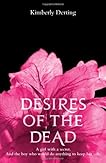
Desires of the Dead by Kimberly Derting

*WARNING If you haven't read book one there are a few very mild spoilers which shouldn't be an issue since they're all predictable. The spoilers only concerns events in book one.*


4
Desires of the Dead is the Sequel to Kimberly Derting's novel, The Body Finder (here), and follows mostly the same story. It's a YA, probably also describable as paranormal, and we've got the same retinue of characters as book one, and the same area, yet the idea you walk away with is that it feels like the same book as the last.

In the Body Finder, Violet found bodies and got involved in the serial killer investigation, though originally against her will. For people unfamiliar with the book, Violet has the unique and chilling ability to find bodies of living things that have been killed. They call to her, and though sometimes she isn't aware, she then starts heading towards the body. Once the body is buried, the calling reduces to a point that it can then be ignored. It's a weird ability, but it's good that isn't something she can turn on and off: it's integral to her life.

So the major point is that the story of this book is practically the story of the last book. There is the element of the FBI interest, but the bare bones of it are exactly the same. Accidentally gets involved in murder mystery, can't help trying to solve. For me, this wasn't too much of an issue. As I said at the start of my Body Finder review, I read and loved this writer because I love her writing and she really seems to know how to pull people into a story; people like me anyway. So even though I was aware the story was the same, I still enjoyed the writing and the characters.

I good thing I don't think I mentioned in the Body Finder review was that every so often, a chapter is told by another person. Usually they are somewhat murderous, and the fact that we don't know who it is until later on makes these chapters creepy but impossibly interesting. One can't help reading them and trying to find the clues which are giving away who it is.

The romance in the book wasn't as unbearable as last time; I mean they weren't kissing all the time. She matured a little bit, but I don't think she was that different. The thing is I like Jay as a character, and I think they're a good couple, but when they are actually being a couple I just want to glaze over. The relationship was in the 'jealous' stage a bit, and I wonder if that was just for story progression, but I never felt the jealousy was founded since there was never chemistry like with Jay and Violet. This might get better.

Her obsession with finding the bodies is explained away as something she can't control, an urge, but she demonstrates that she can overcome it and ignore it if she has to, so I can't understand why she keeps going off on her own in dangerous places. I mean no one is that stupid. It keeps the story going but, if there is another sequel, I think I'm going to get annoyed. Three books of a heroine who isn't using common sense are bound to get on my nerves.

A final point before I conclude, I have to say I liked the new element in the story of Chelsea's life. It was nice to see a less sarcastic (the 'You can kiss my buttocks' kind) Chelsea, and I actually see her more. I kind of love Chelsea's outrageousness and frankness- honesty's the best policy, right? Another of the things I loved in book one was the relationship Violet had with her friends because they seemed real and people who'd be fun to hang out with. We didn't see as much of Jules and Claire this time, but they were always light relief more than actually important.

All in all it was good book, and if you liked book one, you'll probably like this too. The premise is just as interesting and a murder mystery is by its very nature engaging, and I think that most people won't be bothered by the similarities with book one.

Tuesday, 8 November 2011

The Body Finder by Kimberly Derting

5
The Body Finder by Kimberly Derting is a book I picked up merely because I read a post by the author online (an extra scene from the book, I think) and fell in love with the way she wrote. It drew me in like I can’t explain and just had to read her books- all of them- in order to luxuriate in her beautifully engaging writing. The story follows Violet, a girl with the talent to find dead things, as she tries to solve a murder mystery.

The starting of the book was spooky as we watch a four year old girl discover a dead body in the woods. There is a mystery to this part of the book that when solved (in a matter of pages) sent a chill up my spine at the innocence of it. This is probably the best start of a book that I’ve read in a long time and I struggled to put this book down even to wash and eat. I was addicted when I read her writing, but the story itself had its own irresistible charms.

I really appreciated the straight-forward attitude Violet had about her “talent”. There was no beating about the bush or ridiculous cover ups; it was just put plain on show. The prologue (the bit with the four year old) probably helped with this because it gave us an idea about this peculiar ability. And as much as I like the whole coming to terms with it thing in fantasy, having someone already comfortable with their ability at the start was a nice change. In fact, I’m hoping I don’t prefer it!

There’s not a lot I can say about the plot because it is a mystery and I don’t want to spoil anything. The way it worked though was that we had like a learning curve were Violet was only a bit bothered by the murders, so we could learn about her and her life/friends, before it becomes a bit more personal and she actually involves herself. It added believability because, let’s face it, we don’t all rush out to find murderers willy-nilly. Later on, the huge twist was a great shock even though I’d had my suspicions. The climax was good too. When the shot was fired, even though I didn’t think who you are supposed to think had died, did die, I doubted myself because of the clever scent/taste that was attached to the shooter. It made for excellent reading, and I was relieved when I found out the full story.

The romance- always the bane of my reading. At the start, I loved it because unrequited love makes for a much better read for me because we can all empathise with it to a degree. I knew it wouldn’t last- I knew the moment Jay bloody stepped into the book- but it was still great to read. I think knowing, or at least severely expecting, people will end up together makes their exchanges better to read. When they were together though, the kissing got on my nerves. I mean fine, some people will like it and understand better, but for me it just got grating. I know she really, really loves him but does she need to keep proving it? Otherwise though, I liked the pairing because the personalities genuinely seemed to mesh nicely.

Characterisation was another wonderful thing about this book. Jay was unbearably enjoyable to read and I loved his easiness and confidence (as well as him making fun of Violet). It was more believable than the whole love-sick puppy or overconfident bachelor. Chelsea, Claire and Jules were also all relatively believable and funny to read. Claire annoyed me a little, and I knew were Jules was headed, but Chelsea was hysterical and perfect. I wish I had some of Violet’s friends because, let’s face it, there’s some great camaraderie.

So basically I loved this book. I haven’t read many mysteries but the ones I have are always good. I have nothing else to say but buy this book if you like YA and mystery with a pinch of paranormal.

Tuesday, 18 October 2011

Fahrenheit 451 by Ray Bradbury

09/07/2011


4
Fahrenheit 451 by Ray Bradbury is a more classical dystopia in a world where books are against the law and incinerated if found. The reason I like this book is that the premise and the world itself are very clever and believable, but I found the writing itself wanting.

I don’t want to ruin the plot (not that there is much of it) so if I seem vague, assume it is for that reason. All I can say is that it isn’t too important, I think, because it is a book designed to encourage you to think and presents you with ideas; think like Douglas Adams’ Hitchhikers Guide to the Galaxy trilogy of five books. In a nutshell, plot is peripheral, I felt.

The way the world is built in this novel is so understandably logical (and in a way, proven) that one could worry for our own books’ safety. Though the law encourages the destruction of books, books became obsolete before the law came in. It is a book about the most extreme of censorship, stemming from self censorship. In our desire not to offend others, we would censor our books to avoid this offense starting with words and phrases before gradually destroying the book itself. The other reason cited (which is more political) is that society is generally happier when it doesn’t have to think. In the achieving of this hedonism, all thought is stopped by limiting social interaction, confusing ideas and what Orwell coined “doublethink”. How? Television.

It is a different kind of television but it is the idea that these people are your friends and family and that interaction is straightforward with the technology causing you to feel something without having to go through the mental stages of reaching that emotion: through chemicals or colour. I think- this was something I sort of felt my way into understanding because Bradbury was a little wordy, but I’ll explain the way he wrote in a minute.

The other interesting pieces of technology are earpieces that play music to induce a certain mood. Sound familiar? You’re hearing the prophecy of your iPod and MP3 players! These are supposed to distract and occupy humanity. Because as long as we are occupied, we cannot stop to think: so cars drive at unimaginably fast speeds, porches were gotten rid of to discourage leisurely sitting and neighbourly chatting while the law keeps tabs on suspicious morning walkers; all in the interest of reducing free thought.

But away from the story: to prose and writing. I felt that Bradbury was just explicitly in love with ideas. While writing in the plot, he would start off down the winding road of tangent and rambling which- though coherent- made the return to the actual story sort of like dropping into cold water. Nonetheless, it was interesting. Yet, for me, as someone who likes the story to fit like a jigsaw and not just be held forcibly together, I found this way of writing detracted from my complete pleasure in reading. If it had been beautifully written, I would have given it the next point level.

I think if dystopia is your thing (as is abstract) you should read this, ideally before buying. It’s an ideas book and so you need to be ready to learn and absorb otherwise the book becomes are huge mess of utter confusion.

DISCLAIMER :-)
I know I babble and ramble a little incoherently, but that doesn’t mean I don’t find myself annoying as well. I would fix this problem, but it’s too difficult. I don’t have a problem with it, it just distracts me from the book a little.